



Creating a Sense of Urgency

Twenty years ago, Robert Wolgemuth and I started a publishing company. We had a dream to publish books that truly made a difference, in people’s lives and in the overall culture.

Photo courtesy of ©iStockphoto.com/Alst, Image #6564669

Photo courtesy of ©iStockphoto.com/Alst

The only problem was that we didn’t have much money. Our competitors had seemingly every advantage, including piles of working capital (or so we thought). All we had was a dream and our ability to respond quickly.

As it turned out, we signed numerous authors for less than the competition was willing to pay, simply because we moved fast and got the deals done. Many authors were willing to give up some advance money, believing that our hustle in signing them would translate into similar hustle in selling their books. More often than not, they were right.

Thus, responsiveness became our competitive advantage. We could never pay more than our competition and usually offered much less. But we could out-maneuver and out-flank almost all of them. We were lean and mean. As a result, we grew rapidly.

Unfortunately, in the 20-plus years since we began that venture, I have learned that there seems to be an inverse relationship between a company’s size and the sense of urgency embedded in the culture.

More often than not, small companies have a sense of urgency. Why? Because their very survival is at stake. If they don’t move quickly, they get squashed by larger, more established competitors.

On the other hand, it is rare to find large companies that truly have a sense of urgency. Their circumstances rarely demand it. They can continue with business-as-usual and do pretty well. Nothing has to be done today or even this week. Nothing is really at stake—or so they think. Often, by the time they wake up, it’s too late.

But in today’s environment, no one can afford to drift along with the status quo. Growth is not a foregone conclusion. Even survival cannot be taken for granted.

The companies that thrive in today’s economy will be those that can shift their cultures from the slower pace of business-as-usual to urgency. Because of this, I have made “Urgency” our annual theme for Thomas Nelson. I want this attribute to permeate every aspect of our culture. I know we have a long way to go.

But first, we have to understand it. To create a sense of urgency, we must do four things well:
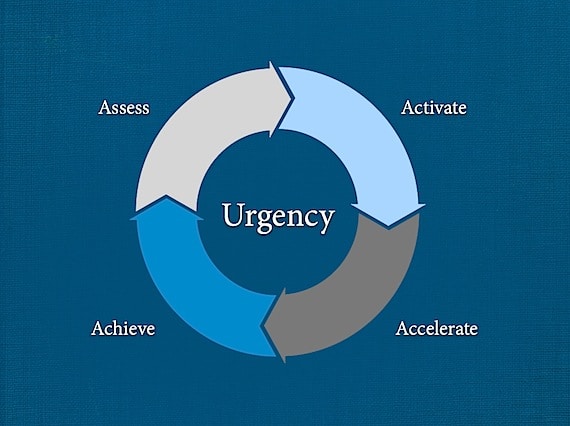
The Urgency Wheel

  1. Activate. Like many larger organizations, we do lots of analysis. Obviously, this can be helpful. No one wants to go into battle without a carefully thought-through battle plan. But as everyone knows, analysis can easily lead to “analysis for analysis sake.” When this happens, the organization becomes paralyzed.

    Often the real issue is courage. The point of absolute certainty never comes. It is foolish to assume that it does. Instead, urgency requires that we activate quickly: Make a decision. Get off the dime. Do something!

    As the old adage goes, “it is easier to steer a moving object.” If you’ve made the wrong decision, you can adjust. But if you wait too long, you miss the opportunity entirely.

    More than ever, people want fast decisions. Speed can be a competitive advantage. But this requires leaders who are willing to activate and get themselves, their teams, and their projects into motion.

  2. Accelerate. Urgency requires more than activation. Yes, you have to start quickly, but you also have to keep things moving. Getting a project green-lighted is only the beginning.

    There are hundreds of impersonal forces (and some personal) that will conspire to slow you down—paperwork, approvals, processes, committees, budgets, etc. Some of these things are necessary—but not as many as you think or the organization would like you to believe.

    It is the nature of bureaucracies to become self-serving. When they do, the process becomes an end in itself. As a leader, you have to fight this. You have to identify obstacles and remove them. You must keep the pedal to the metal and keep things moving. If you don’t, inertia will take over and your project will die.

  3. Achieve. Cultivating a sense of urgency is all about producing results. All the stuff that it takes to produce results—paperwork, approvals, processes, committees, and budgets—are not an end in themselves. They are only the means. If you do all this and don’t accomplish your goals, you have lost.

    Too often people think that the objective is to complete their task list. If they do so, they think they have actually accomplished something. This is not necessarily the case. Tasks are a necessary but insufficient condition of achievement.

    My goal at Thomas Nelson is to create a culture that is outcome-focused rather than task-focused. I don’t care how we produce the results (within the appropriate ethical boundaries), so long as we produce them. We need to stay focused on the what and give our people room to decide the how.

  4. Assess. Urgency does not rule out assessment. In fact, it demands it. If we are going to get faster at producing results, we have to assess what is working and what is not. We must then eliminate the waste.

    Everything should be questioned in light of whether or not it impedes or facilitates the outcome. Does a meeting enable us to move more quickly? If so, great. Call a meeting. But so often we call meetings as a way to procrastinate the decision. Then a single meeting begets more meetings. Before you know it, you’ve built a slow, lumbering bureaucracy.

    The only antidote is to this is to eliminate everything that does not facilitate the desired outcome. Our job as leaders—as opposed to bureaucrats—is to remove the obstacles and give our people the best chance of achieving their goals and ours.

What specifically can you do to create more urgency? Try these:

  • Walk faster—show some hustle.
  • Respond faster to emails and voice mails. Don’t allow yourself to become someone else’s excuse for not getting their work done.
  • Get to the point quickly and insist that others do the same.
  • Keep meetings short and on-point. Always insist on an agenda.
  • Eliminate every piece of paperwork that doesn’t facilitate a specific outcome. My motto: “When in doubt, throw it out.”
  • Be quick to change tactics. If something is not moving you toward your desired outcome, do something else.
  • Do it now!

It’s easy to see a lack of urgency in others, but can you see it in yourself? What else can you do, beginning now, to create a sense of urgency in yourself, your department, and with your projects?

Disclosure of Material Connection: Some of the links in the post above are “affiliate links.” This means if you click on the link and purchase the item, I will receive an affiliate commission. Regardless, I only recommend products or services I use personally and believe will add value to my readers. I am disclosing this in accordance with the Federal Trade Commission’s 16 CFR, Part 255: “Guides Concerning the Use of Endorsements and Testimonials in Advertising.”

Building Champions has been coaching me since 2002. They have taught me to be more proactive and intentional in both my business and personal life. Visit their Web site to learn more and see their special offer for my blog readers.


Related posts:

Print This Post Print This Post

Posted on 30 July 2008

This website uses IntenseDebate comments, but they are not currently loaded because either your browser doesn't support JavaScript, or they didn't load fast enough.

Your Comments

31 Comments so far

  1. jonathan says:

    Great thoughts!

    In the church world, where I work, we have a tendency to spend all our time analyzing and therefore eliminate any sense of urgency in our leaders to see specific outcomes.

    Thanks for the reminder!

  2. Matthew Price says:

    Some excellent thoughts, as always. You have the rare ability to write in a very personal manner that is also business-like and to the point. By the way, you guys (W&H) did some great books but I especially liked your catalogs. They were clever in the same way that a well-conceived annual report can be clever.

  3. Ben Gilliard says:

    Since I have run a small business for the last 31 years, I would say that you are correct. We do respond quicker and with urgency. However, we also become complacent at times and fall into the rut of inactivity and become task oriented. Many of us have already given in to that rut, so much so, that it is now a valley (dark and gloomy). Our goal is to stay ahead of that position even in these hard economic times for retailers.

  4. Onecos says:

    Great post! As a senior manager, I often find that urgent tasks prevent me from completing important matters. It’s often benificial to take time out to see what’s really important. I then try to make that urgent for my staff.

  5. I guess I have the opposite problem. I’m too urgent. Sometimes so much that I forget to stop and rest and concentrate fully on the person who is in front of me–a terrible trait to have as a mother who writes novels and parenting books from home.

    I worry about a culture that presses, presses, presses without stopping to savor real life.

    But again, maybe that’s because I write from home and am not necessarily a part of the dog-eat-dog corporate world. Still, I’m curious what your overall opinion is of the relational aspect of work. Is it simply to relay information from one person to another in the fastest possible way? Is it to achieve certain goals? Is there a place to stop and minister to a needy co-worker? Must it always be about production and being cutting edge?

    I know I’m not conveying tone well here, but my heart is to ask these questions of myself as well. I’m guilty of moving too fast. Of being sure I’m relevant, and cognizant of the trends in the marketplace. I blog, send newsletters, own large writers groups, and train writers. I write two to three books a year. And to be honest, I am tired. Do you get tired too?

  6. Brian says:

    Wouldn’t it be an interesting experiment to have the ability to “rate” your fellow workers’ sense of urgency? We talk about how we are the ones that create and maintain our own “brands”, but I wonder what would happen if people had the ability to rate our responsiveness similar to an Ebay rating… just a thought!

  7. I love this topic, Mike! I run on urgency all the time. A curse sometimes! I’m seldom able to just have a vacation and not think about what I SHOULD be doing. Maybe because I’m that small business by myself and know if it gets done, I need to do it.

    But I wouldn’t have it any other way. It gives me a sense of focus and direction. When you have a sense of urgency, you actually get to see something accomplished.

  8. Gavin Baker says:

    Very timely post for myself – I’ve been thinking about this recently – I particularly liked your tips on how to achieve/build that urgency mindset.

    I’m going to start tomorrow. Thanks!

  9. Geoff L says:

    It is a well timed post from you and exactly what I needed to see pop up on my reader today. What you said is so true about companies, but the same relationship exists for employees and the length of time they are at a company. I like to think of myself as a terribly active and busy individual but honestly who doesn’t. But when I take an objective look at my behavior the last few years, I have lost the spring in my step. I spend more time in meetings and less time doing the work that I love. More time debating policies and less time getting the job done. I remember almost 10 years ago, and look at myself today – I miss that guy.

    At any rate, another insightful post. Thank you!

  10. Working with People You Can’t Be With Daily Report (July 31, 2008)

    The People Part of Working with People You Can’t Be With Dennis Kennedy has a new article on collaborative technologies, about working with others around the corner or around the world. “We based the article on some of the main

  11. David Teems says:

    A very powerful psychology. And it just demonstrates that when everything around us changes, as governments topple or evolve, as culture reshapes itself again and again, the human heart doesn’t really change much at all. Times and histories speed by us, and we are ever the same. This is a great post, and my first thought was the early church. They were on fire; they were wild for what was being offered to them. The young church was like Hyatt & Wolgemuth. Urgency was the rule. Persecution only increased the urgency, and it was the very thing that gave Christianity a start. Governments could not make it stop. And then, as youth tends to do, like you noted, once they had achieved what they had toiled and bled for, once the pace was allowed to slow, the flame receded, or at least lost its initial heat (we might say first love). I am hopeful for the body of Christ still.

  12. leilani haywood says:

    Excellent! I work on a software development team with a team that spans India, Russia, east coast and west coast. Urgency keeps the software team on point. The development is extremely complex but we’ve managed to get the project done with a sense of urgency despite being on different continents, language differences, etc. Get urgent or get out should be today’s business mandate.

  13. A related issue is that talented people often opt out of the larger pools so they can exercise their creative gifts more freely. Look how many great start-ups have birthed from Google or Yahoo or Microsoft as talented people jumped ship and returned to the urgency of survival/start-up mode.

    Thanks for this post; you’re one of the few RSS feeds I actually read word-for-word. Always well worth it. Thank you!

  14. Rob Sargeant says:

    Mike,

    Reading your blog today, I couldn’t help but see how it relates to the state of some churches – where congregations have lost their sense of urgency and expectation. Things week to week become so predictable, and they get bogged down with the means of being a church – going through the motions. The notion that Christ could return any day is lost in the fog of traditions and mundane business. Thanks for the reminder. We should live each day as if it could be our last.

    God bless,

    Rob

  15. Those principles would translate well into being accountable for my hours and writing projects. I think it would be a good idea to create a sense of urgency with work that feels like it could be researched to death!

  16. davidallen says:

    This is very similar to the OODA loop theory of conflict domination by John Boyd… good reading.

  17. Robert says:

    Live Fast, die faster!

    This kind of American way of work only stress people, there are better ways to work more efficiently with less stress.

  18. ewonk says:

    Michael, could I suggest that you read some sort of antithesis to your current perspective on urgency? Maybe read a book on going slow or something to kind of broaden your current mindset a bit, in favor of those working below you.

    As I read through all of the posts above my own, I noticed a few common denominators. Most of the people who are advocating urgency and such seem to revolve around being passionate. Now, that’s all good and well, but as you probably already know, just because our boss is passionate about something and wants it done urgently doesn’t mean that we, the people below the boss, share the same mindset. In fact, in most cases we should NOT share the same mindset as we often do not share the same goals.

    Yes, we want to deliver a product in good time, but NO we do not want to break our back rushing through it because the boss thinks we should. And we especially do NOT want to “walk faster” because the boss thinks it’s beneficial – seriously.

    As a manager of other peoples time and efforts, have you discussed your strategy with the people it would directly effect? What are their thoughts?

    “More often than not, small companies have a sense of urgency. Why? Because their very survival is at stake.”

    THIS, is an incorrect statement. Those companies don’t survive BECAUSE their survival is at stake. I imagine that 90%, if not more, of the companies whose survival is at stake fail anyway. So, the fact that your survival is at stake does not mean you will survive.

    I do like your idea of being outcome driven rather than task driven.

    All in all, your advice, if given to an appropriate party seems OK and maybe beneficial in some sense – I’m hoping this advice is meant for a manager whose sole purpose is to make small through medium sized decisions quickly.

    Just to clear up my standpoint, I read this post as if it were “general advice” and not only directed at managerial decision making and paper shuffling positions in publishing companies. From this standpoint, it’s possible that I might have misinterpreted your advice.

  19. ewonk says:

    Scratch the part where I said you’d made an incorrect statement. You’re right: looming imminent failure is a means to feel a sense of urgency.

    My point was that many many companies have that sense of urgency and still fail. So it seems like a sense of urgency is not a means for success on the whole.

    Reminds me of college football a bit. When I watch college ball, I get the feeling that the guys on the field WANT to win. When I watch pro football, I get the feeling that more of those guys don’t want to win with the same passion that college players want to win.

    Those college players have a sense of urgency.

    However, that sense of urgency seems different. Maybe it’s because all the college ball players have a goals that are closer aligned than the pro players have. And maybe they have those goals that are closely alingned because most of them have that looming sense of urgency over their heads since they ALL are only in college for a limited time. Pro players have very different time frames and contracts so that their goals are probably not as closely aligned.

    Now, the problem with that sense of urgency is that it creates a lot of unnecessary stress. You can align your goals and achieve the same feat in pro ball and in a business as you can with college ball. You can get to the same level of passion/motivation/want-to without that boss-fabricated sense of looming urgency.

    Using the tactic of “urgency” seems rather counterproductive and out of context for a business model. Of course, “urgency” is not the same as “responsiveness”. The word “urgency” just leaves a bad taste on the tongue.

    Again, I’m reading your post as if it were general advice. And as a general reader, this idea of creating a sense of urgency in the work place seems to straddle the idea of creating a sense of importunateness.

  20. Lynn Wheeler says:

    As somebody mentioned to me, this sounds quite a bit like Boyd’s OODA-loop and being able to execute OODA-loops much faster than the competition. Not only is there the sense of urgency … but OODA stands for “observe”, “orient”, “decide” and “act” … also carrying the sense of understanding. This is also frequently referred to as agility … not just faster … but faster & better.

    In the business context, there was claims of studies that found highest correlation with startup surviving the first year or two … was having changed the original business plan one or more times … again agility in quickly being able to adapt the business.

    misc URLs from around the web mentioning Boyd &/or OODA-loops
    http://www.garlic.com/~lynn/subboyd.html#boyd2

  21. Troy says:

    Good subject that we all need to keep in front of us especially those of us who manage a team–lead by example.

    There is a fine line in what we define as chasing urgency. Often, companies, leaders, managers, employees end up replacing results-oriented ugency with too much focus on daily processes (tasks)that yes can be/are important but can also become counterproductive in achieving desireed outcomes.

    Small business are no different than large corporations–there is always something urgent and a level of survival for both. Large organizaitons, corporations, etc are made up of smaller business units for that very reason–to create a sense of urgency to chase more opportunities (to grow the business) than get bogged down in chasing processes. The latter will still get things done but more than not, will leave you feeling task driven rather than outcome driven.

  22. Urgency- because it has to be done NOW, stress- because it didn’t get done, passion- because I feel it so strongly, success or failure- because what I do ultimately has an outcome: this is what we are all dealing with in today’s world. I am often unaware of the things that move me onward, the things that get me to take action. I don’t want to be tyrannized by the Urgent, but I do want to get out of my comfort zone- and fast. You’re right: “no one can afford to drift along with the status quo”. But nor can we afford to live in a frenzied pace while speaking “God’s peace” to the world.

  23. kevin gao says:

    great and inspiring post as always. thanks for the concise, to the point advice on business leadership michael!

  24. “Walk faster—show some hustle”

    My business manager says that when she interviews anyone for a job, she always looks to see if the candidate “walks with purpose.”

    She says the walk reveals urgency or apathy.

    Michael E. Waddell
    Co-author – Toy Box Leadership: Leadership Lessons From The Toys You Loved As A Child

  25. Rookie says:

    Your post reinforced a point from a book I recently read. It’s concept was that “action” is a major differentiating factor between those who are successful, and those who aren’t. I think creating a sense of urgency always follows with taking action.

    However, how do you consistently keep the fire burning to maintain a sense of urgency?

  26. Very Helpful Mike. Thank you. Responsiveness and acceleration are so needed in everyday business. This is key to get executives and key leaders to grasp and lead. Thanks for your thoughts!

  27. I’ve found great advice here:
    http://zenhabits.net/2008/07/the-only-guide-to-happiness-youll-ever-need/

    “15. Slow down. Similar to simplifying, slowing down is just a matter of reminding yourself that there’s no need to rush through life. Schedule less things on your calendar, and more space between things. Learn to eat slower, drive slower, walk slower (unless you’re doing it for exercise). Going slowly helps to reduce stress, and improve the pleasure of doing things, and keeps you in the present moment.”

    I think walking faster is wrong kind of urgency.

  28. As the needs of a company's customer base changes, it is imperative that the company develop a strategy of urgency in order to meet the customers' demands in a timely and effective manner. In this ever changing world, it is important that we try to keep up and change along with it in order to remain in business. A company that refuses to change with the times is doomed for failure.

  29. Not the best post to read right before going to bed, hehe. I feel like I should run and do something, like starting all those things I've been planning to for a while, instead of messing around. Well, hopefully I'll feel the same tomorrow.

  30. KNicholls says:

    It never ceases to amaze me that God puts on your mind and in your heart some of the exact things I need to hear in my day. I love your blog for that very reason.

  31. Mary says:

    Often, I list what needs to be done and start the process of getting it done. I'm focused on the task at hand till completion and reward myself for finishing the project. What is the old cliche? Never put off til tomorrow what can be done today. Im motivated more when rewards await me. I loved your "A" words. Activate,Accelerate,Achieve, and Assess. Good article!


Share your view

Post a comment

I am the Chief Executive Officer of Thomas Nelson Publishers, the largest Christian publishing company in the world and the seventh largest trade book publishing company in the U.S.

  • Restoring the Soul
  • FiledBy
  • Chick-fil-A Leadercast Conference

Twitter Feed

© 2008 Michael Hyatt | CEO, Thomas Nelson Publishers | Powered by Web Design Company Plugins

MilkEngine