

Last fall, the U.S. Federal Trade Commission (FTC) issued new guidelines that require bloggers to “disclose material connections” for product or service endorsements. In fact, according to The Public Relations Society of America (PRSA), “People who blog, tweet or use Facebook to post opinions about consumer products could be fined $11,000 for repeat violations of new federal disclosure rules.”

I don’t know how serious the FTC will be in enforcing these guidelines. I have read some reports that indicate they will be primarily focused on advertisers who attempt to influence bloggers without requiring them to disclose that they were either paid or received free goods or services.
In an attempt to decipher the new FTC Guidelines, the PRSA says,
The FTC dubs them [bloggers] “endorsers” and makes endorsers liable, along with advertisers, for false or unsubstantiated claims or for failing to disclose material connections between the parties.”
What does this mean? It means that if you have a “material connection” with a third-party advertiser or sponsor, you must disclose it. Specifically,
Bloggers who receive cash or in-kind payment (including free products or services for review) are deemed endorsers and so must disclose material connections they share with the seller of the product or service.”
So how do we do this practically? A new Web site called Cmp.ly (as in “comply”) makes it simple for advertisers and bloggers to comply with the FTC guidelines. They have created a series of easy-to-use disclosures and codes that you can use in conjunction with your blog posts, tweets, and other social media interactions. They provide a standard list of six disclosures:
- No Material Connection
- Review Copy
- Free Sample
- Sponsored Post
- Employee/Shareholder Relationship
- Affiliate Marketing Links
They provide graphic “badges” that you can insert in conjunction with your posts. The FTC does not require this and personally, I find them intrusive. I want to comply with the law, but I don’t want an additional distraction or clutter.
Originally, I thought it would be less intrusive to just insert a note after, for example, every affiliate link. As you probably know, if you mention a book on your blog and use your Amazon affiliate code, then Amazon will pay you a small commission when someone clicks through and buys the product. This approach looked like this:

However, after living with this for the past 30 days or so, I feel this is also cumbersome and intrusive—especially if you have numerous links within one post, like I do here.
Therefore, I have decided to include one blanket disclosure at the bottom of every blog post. Rather than using a badge, I am using a simple block of text. I am using a smaller font (though still readable) and a slightly lighter color. This approach looks like this:
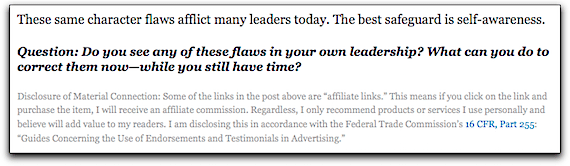
You can scroll down to the bottom of this post to see how it looks “live.” I currently have the following six disclosure templates. I am inserting at least one at the end of each post.
- Disclosure 1: No Material Connection. This is the standard disclosure I use when I don’t have any embedded links or a relationship with any of he products or services I have mentioned:
Disclosure of Material Connection: I have not received any compensation for writing this post. I have no material connection to the brands, products, or services that I have mentioned. I am disclosing this in accordance with the Federal Trade Commission’s 16 CFR, Part 255: “Guides Concerning the Use of Endorsements and Testimonials in Advertising.”
- Disclosure 2: Affiliate Links. This is the disclosure I use when I included an embedded affiliate link from Amazon or some other provider:
Disclosure of Material Connection: Some of the links in the post above are “affiliate links.” This means if you click on the link and purchase the item, I will receive an affiliate commission. Regardless, I only recommend products or services I use personally and believe will add value to my readers. I am disclosing this in accordance with the Federal Trade Commission’s 16 CFR, Part 255: “Guides Concerning the Use of Endorsements and Testimonials in Advertising.”
- Disclosure 3: Review or Sample Copy. This is the disclosure I use when I am reviewing a book or other product that I have received from someone in the hope that I will review it:
Disclosure of Material Connection: I received one or more of the products or services mentioned above for free in the hope that I would mention it on my blog. Regardless, I only recommend products or services I use personally and believe will be good for my readers. I am disclosing this in accordance with the Federal Trade Commission’s 16 CFR, Part 255: “Guides Concerning the Use of Endorsements and Testimonials in Advertising.”
If you are a Thomas Nelson Book Review Blogger, you might want to use this disclaimer:
Disclosure of Material Connection: I received this book free from Thomas Nelson Publishers as part of their Book Review Blogger program. I was not required to write a positive review. The opinions I have expressed are my own. I am disclosing this in accordance with the Federal Trade Commission’s 16 CFR, Part 255: “Guides Concerning the Use of Endorsements and Testimonials in Advertising.” - Disclosure 4: Sponsored Post. This is the disclosure I use when someone pays me to write a post for a product, service, or conference. I turn down more of these posts than I accept, because I have to be genuinely excited about the product:
Disclosure of Material Connection: This is a “sponsored post.” The company who sponsored it compensated me via a cash payment, gift, or something else of value to write it. Regardless, I only recommend products or services I use personally and believe will be good for my readers. I am disclosing this in accordance with the Federal Trade Commission’s 16 CFR, Part 255: “Guides Concerning the Use of Endorsements and Testimonials in Advertising.”
- Disclosure 5: Employee/Shareholder Relationship. This is the disclosure I use when I am writing about a book my company, Thomas Nelson, has published.
Disclosure of Material Connection: I am the CEO of Thomas Nelson, the company that published this book. Regardless, I only recommend books that I have personally read and believe will be good for my readers. I am disclosing this in accordance with the Federal Trade Commission’s 16 CFR, Part 255: “Guides Concerning the Use of Endorsements and Testimonials in Advertising.”
Feel free to borrow this method or any of my disclosure copy. If you improve upon it, I’d love to hear about it in the comments below.
If you are using WordPress, you can also automate this whole process by using a plugin called Add Post Footer. Just put your default text in the plugin configuration page. I use Disclaimer 2 above for my default. Then you can then override this on a post-by-post basis, using a custom field. The plugin documentation explains how.
This space is currently available, but it won’t last long! Click here to find out how you can advertise in this space.
Related posts:


In:
Tags: 

Useful templates – thanks for posting.
Sad that we have to go through the hassle of all this. I honestly don't know much about the specifics of the FTC deal here but it sure seems like more unnecessary red tape and micromanagement. I’ll look it up but do you know the WHY behind this? Was there a tangible reason that forced the FTC to step in and force their hand in this? Kind of seems like it should be my choice to link where I want to, how I want to as a method of my free speech BUT if there is some abuse going on… I guess I can understand the potential issues and desire for transparency in some way.
I don’t really know. It does feel over-reaching to me. Like most government regulation, they use an exception to penalize everyone. It is frustrating and intrusive. I think it also takes a very low view of readers—as if they don’t know that something is a paid opinion.
Regardless, I do think disclosure is a good thing. We need more transparency. Now if the government itself would only be more transparent!
Michael, Your reply here sums up my thoughts exactly. How can our government enforce their demand for transparency with us and then do most of their business in closed-door sessions? The disparity is almost slapstick.
Sometimes I think that lawyers and law-makers have one goal: to take the simple and make it complex, thereby taking the fun out of life.
My recent post Goodbye Granddad, We Love You
Haha. True. Wish we could impliment a policy on Washington in this way. Give them a dose of their own medicine. Maybe a “disclose material connections” for bills would help really show the pork for what it is and give us a real perspective of who is in bed with who.
My recent post DanielDecker: RT @gailhyatt: The reason people blame things on others is that there's only one other choice. ~Doug Larson // ouch :)
Thanks for the info. and to answer your question "What am I doing to comply w/ FTC guidelines?" Uhh not much before reading this post. :) Thanks for the info.
I would venture to say that many bloggers are out of compliance. LOL
My recent post Be Careful What You Tweet
I don’t that the FTC is going to come after many bloggers—at least initially. I think they have their eye on advertisers. Worst case, is that they will send letters to violators and only prosecute repeat, egregious offenders.
Michael, thanks for the help with this tricky subject. I like your idea of using an unobtrusive footer instead of badges or other in-post distractions. With the footer plug-in for WordPress, I can make a default affiliate links note at the bottom of most of my posts. This will save me hours of time going back and marking each one of my book links.
Can you imagine if they had to do this in the movies? Every time a box of cereal or any recognizable object came into view there would be a little cloud pop-up that says "affiliate reference." :)
My recent post Set a 12 Week Goal
Yea, I wish the FTC would at least be fair in their application. This seems like they are picking on bloggers because, unlike Hollywood, we don't have a unified industry to speak up for us.
I'm surprised that Amazon and other large affiliate companies haven't come up with a different solution or at least given bloggers some guidance on this. Maybe a javascript popup on book links?
My recent post A Quick Way To Remember Your Goals
Thanks for the direction and examples Michael. I was hoping that just adding something to my blog page would be enough, but just to be safe I will prepare something like you've done.
My recent post The Nook experience from my perspective!
Thanks for the direction and examples Michael. I was hoping that just adding something to my blog page would be enough, but just to be safe I will prepare something like you've done.
My recent post The Nook experience from my perspective!
That’s exactly my point. I’d rather be safe than sorry.
At the moment I'm just putting "Review copy provided by………………… " at the bottom of my posts reviewing books i have been given free. When i get time i may also do a post explaining that other links i make to charities or worthwhile offers involve no material connection
My recent post Featured song: Hillsong- higher
At the moment I'm just putting "Review copy provided by………………… " at the bottom of my posts reviewing books i have been given free. When i get time i may also do a post explaining that other links i make to charities or worthwhile offers involve no material connection
My recent post Featured song: Hillsong- higher
Well done Michael, thanks.
What method of disclosure (if any) are you now using in your tweets?
My recent post How to find a Christian lawyer
Right now, I am not using any. I can't figure out how to avoid two links. For example, if I tweet about a book and provide a link to Amazon, I should disclose that the link is an affiliate link. However, that requires another link to my disclosure. Or at the very least, I should put [affiliate link] in brackets, but that is cumbersome, too—not to mention the fact that this all takes up character spaces in a 140-character tweet.
For the time being, I am just avoiding any tweets that would require a disclosure. I am hoping someone will come up with a less intrusive way to comply with the FTC Guidelines.
I have the habit of tweeting about books I am reading, and using Amazon affiliate links. I understand the need for transparency, but adding legal disclaimers to tweets seems like overkill.
My recent post Book Review: Perspectives Old and New on Paul
If you are just tweeting to with the link to a blog page with the disclosure, is there a need for a second disclosure? For example, the auto tweet that is sent out on new blogs from WordPress.
If so, then if you are TN book review blogger and you retweet a review of a TN book, then you need a disclosure for yourself. WAY to confusing there.
My recent post The Nook experience from my perspective!
In my humble opinion, Michael. You offer some of the very best and most practical advice for bloggers. Thank you so much for this post!
My recent post An Open Thank You To The Staff of The Oregonian
Thanks for the information. It seems very intrusive to use a badge from Cmp.ly and I appreciate your footer and the ability for your readers to use them on their own blogs. (I have bookmarked this for easy reference.)
It will be interesting to see how this develops. I imagine the FTC will see this as onestep to a bigger pictures instead of a end of the process.
Justmy thoughts,
Chris Gallagher
My recent post Monday Morning Blues – More Jeff Allen
Excellent and thanks sharing your simple samples!
thanks for the heads up – I will be putting up my disclosure soon.
and thanks for the plugin recommendation
My recent post FriendFeed FTW
Why not simplify the blogging region and add a general disclaimer at the very bottom of the page – not the blog post but the actual page?
I definitely think that is an option. I personally wanted it closer to the actual post, so that it is clear. However, some bloggers are just including a separate page or a note in their sidebar.
Thanks. I was thinking in terms of usability. The further distance from end of blog and comments section, I would think would decrease the likelihood of user adding comments.
Would such a disclaimer be required on the RSS Feed?
My recent post FriendFeed FTW
I haven't been doing anything to comply, nor was I aware that this is why so many bloggers have been using similar disclaimers lately. I feel it makes the writer seem less authentic. I generally trust that a blogger (even if compensated with product) will be honest in her or his review and will probably only review products she or he really believes in. Calling attention to the compensation makes the blogger seem more like a business, and therefore less approachable.
All that said, I probably should use #5 now and again. I am an editor and though my blog is primarily personal and not widely read, I do write about some of the better books I work on.
My recent post Kate in the Snow
Well, then, there IS another ramification to consider:
Disclosure of Material Connection: I have or will compensate the United States Treasury and the State of ___ Franchise Tax Board for writing this post since I have received income in the free market system elsewhere. I have a material connection to services provided by same including use or receipt of public safety, infrastructure and various intrusive and intimidating tactics they use to keep me in control. I am disclosing this in accordance with the Federal Trade Commission’s 16 CFR, Part 255: “Guides Concerning the Use of Endorsements and Testimonials in Advertising.”
As a new blogger, I had no idea about the FTC requirements. Very helpful post. Thanks!
My recent post Birthday Weekend #1
I typically read your blog in my Google Reader. I wanted to point out that your disclosure note does not show up in the RSS feed. I haven't read the FTC documents myself so I'm not sure if they require disclosure to be present in feeds, but it certainly would stand to reason. Is that a limitation of the Add Post Footer plugin or by design?
My recent post My Soundtrack for 2009
This is a limitation of the plugin, though I have written to the developer about it. Regardless, the FTC doesn’t provide any practical guidelines—that's part of the problem.
I typically read your blog in my Google Reader. I wanted to point out that your disclosure note does not show up in the RSS feed. I haven't read the FTC documents myself so I'm not sure if they require disclosure to be present in feeds, but it certainly would stand to reason. Is that a limitation of the Add Post Footer plugin or by design?
My recent post My Soundtrack for 2009
As always you post extremely useful information. I'm not getting paid for endorsements yet but will definitely use these disclosures if I ever do. Thank you Michael and God Bless you for sharing your wisdom.
My recent post Panko Parmesan Tilapia
I am definately thankful that I live in Australia and the FTC has no effect on me.
My recent post Squeeze Page Tips For Better Conversion
What a coincidence: I read about these new guidelines in Writer's Digest for the first time today. I understand the need for transparency–I want to know if a reviewer was financially compensated or affliated with the product/company–but it seems like such a hassle. I've recently started blogging but haven't ventured into this particular territory before. Glad to have a heads-up . . . but all these legal regulations make my head hurt! Someone pass the aspirin, please.
Thanks! That was valuable information.
My recent post Smells only slightly better than the odor that you're trying to mask
Thank you for taking the time to share this! This will be super helpful for many people. I am a Thomas Nelson book reviewer, and I love doing it. :)
My recent post Shoes For Lydia
So, let me see if I understand the implications for my blog. As long as I don't sell anything, recommend a product or a service, advertise, or review someone else's creation, I don't have to worry about the guidelines. Correct?
My recent post #26 UNDERSTANDING CHRIST: OUTCOMES OF THE CROSS
That is correct.
Thanks! I knew I could count on you to sift through all the info and make sense of it!
My recent post #26 UNDERSTANDING CHRIST: OUTCOMES OF THE CROSS
What am I doing to comply? I'm going to copy your templates and use them in my blog. Thanks for doing the legwork. Much appreciated.
Wow! Great stuff here. Thanks so much for the insight and help. One of the pages on my blog is a disclosure explaining what my affiliate status is with the brands and resources I promote. This post gives some much needed clarity to the process. Many thanks.
This regulation appears on its face to be a blatant violation of the First Amendment. If I speak offline and say that I really love Law and Order, I'm exercising my First Amendment right. If I say the same thing in a blog, I have to state whether or not I have a "material connection" with NBC? I think not! I'd love to see these idiots try to take a case to court.
Supporting the First Amendment,
-Steve
Disclosure of Material Connection: I received the protection of the First Amendment to the Constitution of the United States free at birth. Regardless, I only recommend Constitutionally guaranteed rights that I use personally and believe will be good for my readers. I am disclosing this in accordance with the Federal Trade Commission’s 16 CFR, Part 255: “Guides Concerning the Use of Endorsements and Testimonials in Advertising.”
The First Amendment doesn't apply to commercial speech in the same way that it applies to noncommercial speech. That's why it's illegal to say "This snake oil cures cancer. Give me $1,000." unless your snake oil *really does* cure cancer.
As a co-founder of CMP.ly, I wanted to add some insights. First, I would like to thank Michael for addressing this complex issue with a thought out and simple solution. When we first announced our CMP.ly disclosures, we set out to create a standardized code system that would be clear and concise, but also flexible to suit the individual needs of bloggers and advertisers.
A few things that I would like to clarify are:
- Our solution is not badge based. In fact, visual badges are not officially supported as part of our disclosure solution at this point. Our disclosures are based upon a series of short URL codes that clearly indicate the type of disclosure being made. We do hope to incorporate badges in the near future.
- With each of our short URL codes, there is an accompanying full text disclosure that is intended to be used wherever space permits (i.e. short URLs in Tweets, and a combination of short URLs and full text disclosure in your posts).
- Furthermore, our unique disclosure engine, which was launched in December, allows for users to create their own unique disclosures that use our standard code framework, but allow the user to identify themselves, the specific nature of their disclosure and any additional notes. This also allows the user to manage all of the disclosures that they have created in one place.
- To be clear, all of the disclosures that Michael has outlined here could be set up in CMP.ly and could be linked with a short URL (for example I just created http://cmp.ly/0/e9qkhw). This link can be used in Tweets and will remain intact in RSS, email and other syndication when your blog content is read outside of the context of your own blog. As Andrew pointed out in the comments, RSS syndication can strip out page disclosures and badges and the FTC has been clear that the disclosure must follow the content to where the reader sees it.
- All of the above tools have been offered to the community for free along with the standard disclosure codes.
- We are preparing to launch a set of paid tools that will allow advertisers (brands, agencies and networks) to manage disclosures across multiple brands and campaigns. The FTC has made it clear that advertisers are responsible for ensuring that their campaigns include disclosures and that they 1) lead the conversation about disclosure, 2) create a policy for disclosures and demonstrate that they have followed a process to include disclosure in their endorsement campaigns and 3) monitor those disclosures on an ongoing basis. Our campaign manager tools will accomplish all of this in a turnkey but flexible system that allows the advertiser to include their own policy and best practices guides and to pre-select the disclosure for a specific campaign. When CMP.ly solutions are used, an advertiser can easily identify a disclosure and know with certainty which campaign the user participated in and which language is being used in the disclosure.
- Moving forward, we believe that advertisers who engage in blogger relations and endorsement or affiliate marketing programs will need to address the management and monitoring of disclosures across multiple brands and campaigns. Advertisers will need to lead the disclosures around their campaigns, but they will need the support of the blogging community to do so effectively. At CMP.ly, we have tried to address the needs of both communities in an open framework that allows for customization and personalization. The advantages to using a standardized system like CMP.ly will make it easier for advertisers and writers to work together to market products and provide the transparency and accountability that are required under the revised guidelines.
I really like the way that Michael has used the Add Post Footer solution here, and I will see if we can use that to fast track our WordPress integration. We are working on solutions to further shorten URLs, to create trackable badges and to solve the two links issue. We are continuing to develop our platform and we are open to community feedback. The blogging community has been incredibly supportive and that feedback has played a large role in shaping the CMP.ly solutions that you see today.
Tom, thanks for such a thorough reply. I found it VERY educational.
I look forward to your continued development efforts on a WordPress plugin. If I can help, either in the testing or the promotion, I would be happy to do that.
Thanks again.
This gives me much food for thought. Thank you for sharing several disclaimers and allowing us to "borrow" them, and for the info about the Add Post Footer WordPress plugin. I'll definitely use both!
I can understand why the FTC needs to institute these policies, but frankly, it sounds like a nightmare for those of who use social media extensively.
My recent post Improve Your Blogging… Binge on a Fiction Author
We live in a very complicated time, don't we? So many laws, and experts, and piddly things to think about. Anyway, thanks for putting together these templates. I haven't been blogging long, but already see how I'll be needing them. In fact, tomorrow!
These are handy. Thanks for posting these templates!
Great ideas Michael. Thanks for sharing
Thanks for the direction and examples. As always you post very useful information. I will definitely use these disclosures if I ever get paid for endorsements.
My recent post Buy Only Stocks That Pay Dividends
Dear Michael,
I have finally got some time and decided to write a review of It by Craig Groeschel which I received from you during your Book Notes review on this book. Thank you. It was a fantastic book – most of the wisdom there are common sense wisdom that Craig has put it in such a way that are so passionate, energetic and inspiring to read and apply.
I was searching high and low for this blog post to look for guidelines to comply to US FTC regulation.
Probably it would be a good idea if you could make this post sticky or pin it to your list of popular posts?
I'll take a look at doing that. Did you attempt to use my search bar in the top right-hand side of the blog. I entered “FTC” and it came right up. Thanks.
Yes, I finally thought of that..which is when I arrived at this post.
Thank you so much for posting the various verbiage in compliance with the FTC rules. I just became a Book Sneeze reviewer and just found out about the October 2009 ruling. This is a huge help to me. Thanks again.
Thanks. These are very helpful and perfect timing for me.