


The 7 Benefits of Keeping a Daily Journal

Though I typically write several thousand words a week, I have never been a consistent journaler. I’ve tried. I have friends who swear by it. It’s just never worked for me.

Diary and Coffee on a Newspaper - Photo courtesy of ©iStockphoto.com/neomistyle, Image #15713596

Until recently.

My wife Gail and I have been on an extended vacation for the past two weeks. We have been tucked away in the mountains of East Tennessee on the edge of a beautiful lake.

When we arrived, Gail challenged me to keep a journal. I rolled my eyes but reluctantly agreed to give it another try, evidently forgetting a previous post I had written on the difference between trying and doing.

So far, I have written daily for twelve days in a row. I’ve surprised both of us.

Here’s how journaling has worked for me in this setting.

  • Gail and I get up at about 5:30 a.m. (Yes, even on our vacation. We can’t help ourselves.)
  • We read the Bible on our own while drinking a cup of coffee. I’m currently reading through The One Year Bible (Tyndale).
  • When we finish, we grab our journals and walk down to the dock. It’s only about twenty yards away.
  • Then we sit quietly for fifteen minutes. No talking, no writing. No doing. Instead, we silently take it all in, give thanks, and pray. We take time just to be.
  • Finally, we crack open our journals and start writing. This is completely unstructured. We don’t edit. We don’t judge. We just get it out. We write for twenty to thirty minutes.

I might write about what I read in my Bible, a dream I had last night, an experience I had yesterday, or what I hope to accomplish today. Sometimes I will write on one topic; sometimes on four or five.

The main thing is I am writing for myself rather than an audience. I have found this tremendously liberating and deeply satisfying. Amazingly, I am effortlessly writing five hundred to a thousand words a day.

If I had to sum it up, I would say journaling has afforded me seven benefits. It has enabled me to:

  1. Process previous events. What happens to me is not as important as the meaning I assign to what happens to me. Journaling helps me sort through my experience and be intentional about my interpretation.
  2. Clarify my thinking. Writing in general helps me disentangle my thoughts. Journaling takes it to a new level. Because I am not performing in front of a “live audience,” so to speak, I can really wrestle through the issues.
  3. Understand the context. Life is often happening so quickly I usually have little time to stop and reflect on where I am in the Bigger Story. Journaling helps me to discern the difference between the forest and the trees.
  4. Notice my feelings. I understand feelings aren’t everything, but they also aren’t nothing. The older I get, the more I try to pay attention to them. They are often an early indicator of something brewing.
  5. Connect with my heart. I’m not sure I can really explain this one, but journaling has helped me monitor the condition of my heart. Solomon said “above all else” we are to guard it (see Proverbs 4:23). It’s hard to do that when you lose touch with it.
  6. Record significant lessons. I’m a better student when I am taking notes. Writing things down leads to even deeper understanding and, I hope, wisdom. I want to write down what I learn, so I don’t have to re-learn it later.
  7. Ask important questions. A journal is not merely a repository for the lessons I am learning but also the questions I’m asking. If there’s one thing I have discovered, it’s the quality of my questions determine the quality of my answers.

Will I stick with this after my vacation? Time will tell. I sure hope so. So far, it has been one of best personal development exercises I have done in a long, long time.

By the way, I started out writing in my Ecosystems journal. However, I am not the best at writing lots of text by hand. The legibility of my writing deteriorates quickly.

On day three of my journaling experience, I stumbled upon a software program called Day One (not an affiliate link). This is a beautiful minimalist writing tool that reminds me a lot of ByWord, the program I use to do most of my professional writing.
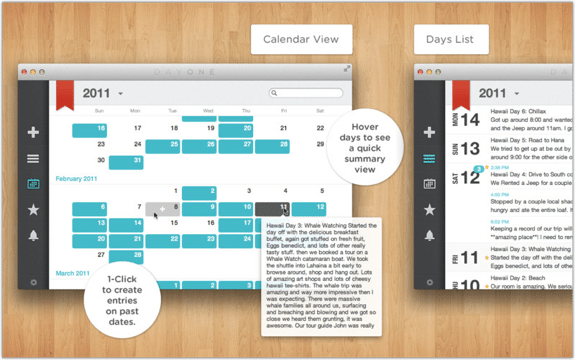
Day One Screenshot

Day One sports:

  • A simple, uncluttered writing area.
  • iCloud and DropBox sync to iPad and iPhone.
  • Password protection (though not encryption yet).
  • A calendar view, allowing you to jump quickly to a specific day.
  • MultiMarkdown support, which is a formatting language I have grown dependent on. I use it in ByWord.
  • A fast, intuitive search engine that allows me to retrieve my notes instantly.

Best of all, it is only $4.99. I only wish the Apple app store allowed for trial versions of software, so you could experience the beauty of this program before you buy it.

Regardless, the tool is unimportant. The main thing is for it to become invisible, so you can focus on writing and reflecting.

Question: Do you journal? If so, what has been the primary benefit to you? You can leave a comment by clicking here.
Set up a self-hosted WordPress blog in 20 minutes or less by watching my step-by-step screencast. Also, get a discount on BlueHost web hosting. It is the only hosting service I personally recommend. Learn more ….

Please note: I reserve the right to delete comments that are snarky, offensive, or off-topic. If in doubt, read My Comments Policy.

  • Pingback: Experts Recommend Journal Writing — Journal in a Box TM

  • Deb Osorio

    I journal rather sporadically. I’m trying to get better with it. Thank you for this article.

  • Pingback: New Year, New Journal | MorrisMatters.com

  • Pingback: David Brainerd—A man who kept a journal | Past and Present

  • Pingback: Turn Your Passion Into A Discipline: 7 Tips To Accelerate Your Journey Towards Fulfilling PurposeMoyo Mamora | #BeInspired

  • Pingback: 51 Attitude Hacks: A Cheat Sheet for Positive Mental Fortitude | Scott Ross Online

  • Luci Swindoll

    Loved your blog, Mike and your seven reasons for Journaling make perfect sense to me. I’ve journaled daily for the past 26 years, and have kept those “chronicles of life” in my library, referring to them all the time. One of the primary reasons I love having them handy is that when I write a letter, essay, devotional or book, I can refer to my journals knowing the information will be accurate because I recorded it the day it happened…or the day I felt what I wrote. I’ve often said if my house were on fire, my journals would be the first thing I’d grab before I ran out! A journal is a place of self-reflection, to which I turn when I want to either relive what happened, or re-create what can so easily fade in one’s memory.

    Congratulations for journaling Mike. I wish you well with this venture. Hopefully, it’ll be a source of joy and discovery about yourself and your thoughts for many years to come.  There are so many things about you I admire…and this is one of them. 

    • http://michaelhyatt.com/ Michael Hyatt

      Thanks, Luci. You are precious for stopping by to comment. I have seen your journals in your library, and I so admire (actually envy) that you have kept up with it all these years. You are an inspiration.
      Hope you are well. Gail and I miss you!

  • http://twitter.com/hisadventure Rocio

    As always, I appreciate you taking the time to share this information.  I have recently been journaling again, and yet, much like you, I find it so much easier (faster) on a keyboard.  However, for now, it’s paper, and for me it has helped focus my mind on things of God, even if I don’t write about God.  For that alone, it’s priceless!

  • http://christinefaour.wordpress.com/ Christine Faour

    I journal just about every morning, and have been doing so for a few years. It helps clarify my feelings, sort them out and classify them. It is also my own sounding board for things I want to do in my creative life. Lastly, journalling helps me get the worry and negativity out of my thoughts so that I can get on with my day. When I reread my journal entries over a period of time, I detect certain themes that show me where I’m putting my energies and thoughts.

  • Brian Tomlin

    I have been journaling since high school, and I find the longer I keep it up, the more I get out of it. I frequently refer back to my old journals to look things up: restaurants, quotes, etc. But most importantly I learn amazing things about my thought process, my decision making. So often the right course to take or decision to make is revealed long before I consciously realize it. I encourage anyone to stick with it. 

  • Pingback: By popular demand : What we are using 2013 « 3hlearning

  • Pingback: Food Journal 30 Day Challenge | 30X1.com

  • Peter j Foster

    Many years ago, as a young man, I went on a 4 week exploration of USA (I’m from UK). I’d driven for days and days alone and found myself in Palm Springs. I checked  in to a Motel early evening and sat in my small room, very lonely and very miserable. I couldn’t understand what was wrong with me – miserable to the point  of depression.
    I had a sudden urge to write but found no paper. It was by then 11.30 pm. I went off in the car to find writing paper. An hour or so later I returned, having brought a large A4 note book. I sat on the bed and wrote and wrote all night. 
    I was clearly depressed. I wrote about feelings from childhood, my youth and the dissapointments of my later life. There were broken relationships, un-realised dreams; there was loneliness and even self-hatred.
    From that night onward I have written a daily journal – and wouldn’t (couldn’t) be without it! It has helped me to forgive others who had hurt me. It has been my counselor, my therapist and most importantly it has been the chief factor in recognising my need for a Savior. My journaling clearly led me to a relationship with God, through Jesus. And I have never looked back.  
    Keep up the Journaling. Peter j Foster (Christian Journaling Coach)

    • http://theordainedbarista.com/ Barry Hill

      Peter,

      Thanks for this heartfelt testimonial to the power of journaling. Is there any piece of advice that you end up giving out to people who are thinking about journaling? Any pitfalls?

  • Pingback: Change Your Life with These 7 Actions

  • Steve

    I use http://www.sojo.co
    to journal. Its really cool. It uses my facebook, google + or twitter
    account to help jog my memory. Allowing me to catch the rest of the
    story to the items I’m writing on my social medial sites. 

  • Pingback: Writing Down Your Thoughts: Manly or Stupid? | Stud Studies

  • Pingback: Getting Started Journaling | My Pleasant Places

  • Pingback: To Do | MISRED | blog