
Recovering the Lost Art of Note Taking

I spend most of my work-life in meetings. Note-taking is a survival skill. Yet, I am surprised at how few people bother to take notes in meetings. Those who do sometimes express frustration at how ineffective the exercise seems to be.

Photo courtesy of ©iStockphoto.com/webphotographeer, Image #5468594

In this post, I’d like to expound on why I think you should take notes in meetings and then offer a few suggestions on how to do it better.

  1. Note-taking enables you to stay engaged. The real benefit is not what happens after the meeting but during the meeting itself. If I don’t take notes, my mind wanders. I daydream. As they say, “the lights are on, but no one is home.” However, when I take notes, I find that I stay more alert, focused, and actively involved. My contribution to the meeting is thus more likely to add value to the topic under discussion. This is why I take notes even if someone is officially taking minutes.
  2. Note-taking provides a mechanism for capturing your ideas, questions, and commitments. Not everything can be resolved in the meeting. Some ideas require incubation. Questions require further research. Commitments require follow-up that cannot be done until after the meeting. Regardless, note-taking provides a way to capture the content of the meeting, so that I can processes it after the meeting.
  3. Note-taking communicates the right things to the other attendees. When someone takes notes, it communicates to everyone else that they are actively listening. It also communicates that what others are saying is important—it is worth making the effort to record their insights. If you are in a leadership position, it also subtly establishes accountability. Your people think, If the boss is writing it down, he probably intends to follow-up. I better pay attention. As a leader, your example speaks volumes. If you take notes, your people will likely take notes. If you don’t, it is likely they won’t.

But how can you more effectively take notes? There are numerous note-taking systems. Here is the one I use:

  1. Use a journal-formatted notebook. If you have something else that is working, great. Stick with it. If not, I recommend one of the Moleskine notebooks. The name (officially pronounced mol-a-skeen-a, although it can vary) comes from the French spelling of ‘moleskin,’ which the oilcloth covering resembles. I have used the Large Ruled Journal for years and never go anywhere without it.
  2. Keep your meeting notes as a running journal. I give each new meeting (or topic) its own heading, along with the current date. The notes run continuously until I fill up the journal. Then I begin a new one.
  3. Use symbols so you can quickly scan your notes later. I indent my notes from the left edge of the paper about half an inch. This allows me to put my symbols in the left margin. I use four:
    • If an item is particularly important or insightful, I put a star next to it.
    • If an item requires further research or resolution, I put a question mark next to it.
    • If an item requires follow-up, I put a ballot box (open square) next to it. When the item is completed, I check it off.
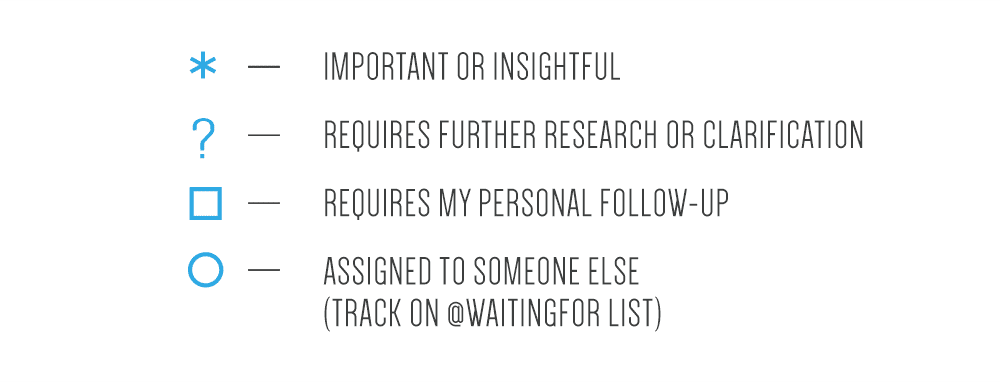
    • If I have assigned a follow-up item to someone, I put an open circle next to it (similar to the ballot box but a circle rather than a square). In the notes, I indicate who is responsible. When the item is completed, I check it off.

    Here’s a slide I use in my speaking when I teach this method:

    smart-notes.008.jpg

  4. Schedule time to review your notes. This is the secret. I scan my notes immediately after the meeting if possible. If that is not possible, then I do it at the end of my workday. If I miss several days, I do it during my weekly review. Regardless, I take action on those items that I can do in less than two-minutes. Those that will take longer I enter into Entourage (or Outlook for you PC users) either as a task or an appointment.

Note: I originally wrote a version of this post several years ago. However, it was buried deep in my archives. I think it is as relevant now as when I wrote it. So I have dusted it off and published this new version.

Question: What do you find helpful when you are taking notes? You can leave a comment by clicking here.
Set up a self-hosted WordPress blog in 20 minutes or less by watching my step-by-step screencast. Also, get a discount on BlueHost web hosting. It is the only hosting service I personally recommend. Learn more ….

Please note: I reserve the right to delete comments that are snarky, offensive, or off-topic. If in doubt, read My Comments Policy.

  • http://levittmike.wordpress.com levittmike

    I cannot count how many times my notes have saved my backside.  In most of my roles, I have had so many things/ideas/comments thrown at me, if I didn’t write them down, they would either be forgotten, or not dealt with in a timely manner.

    Note taking also (for me anyway) reduces those 3am wake-up from a deep sleep, fretting about something I forgot to do.

  • http://www.LaRaeQuy.com/ LaRae Quy

    Thanks for validating the old tradition of taking notes! I do it all the time because it “sets” the information in my mind. I find that if I write a mission or goal down, it’s set in stone. Our ancient ancestors had something there! 

    As the spokesperson for the FBI in Northern California, I was beset by reporter demands, meetings, public debriefings followed by  classified debriefing (and please, do not get the two confused!), and a host of other conversations. All in one hour, and then on the next hour . . . the point being, keeping notes kept my life organized. I could always flip back to my earlier pages to accurately reflect upon what had transpired. I’ve tried it with my “devices” but they are simply not as efficient – at least, for me. Who knew . . .

  • http://darensirbough.com/ Daren Sirbough

    I am trying to integrate audio of the meeting with the notes I actually take during a meeting. Evernote makes that easy though I hardly use the Audio because it is at such a low quality and often I don’t listen to it anyway. Learning how to take notes effectively is on my (to-do) list.

  • Jon

    I use a separate notebook for each major project at work.  I’m often the only one who has a complete record of what was discussed at project meetings or teleconferences. n Has saved my bacon many times!

  • Amelia Cabealotu

    Thank you very much for this great advise and I totally agree on taking notes when in a meeting.We tend to forget a lot after a meeting especially when you have a busy day or behind in your daily task at work or even home.And mostly I dont have time to go through those follow ups or some very key issues raised during meetings.But what I have learnt and tried to follow or keep up with is,never to miss what I termed as ‘MY QUIET TIME’ where I lock myself in my room after a days work and retrack or recollect all that I that I had done on that day and thanking the Lord for his guidance and grace.Thats when I was able to note down and recall those follow ups from the days meeting and was able set my tasks and plans for the next day.Trust me this has really worked for me and and thankful about it and when I am not able to do it in a day or two ,I made sure that Sunday before going to bed is my best quiet time.It has indeed helped me in understanding my life ,my learning new things and ideas and and at the same time exercising my brain.Once again thank you for this reminder ans inspirational piece.I love it.

  • Pingback: markwilson.it » Returning to the analogue world of note-taking

  • Carol Johnson

    If you keep meeting notes in the moleskin – how do you keep everything for 1 meeting or an ongoing project together if they are all randomly in the notebook and you don’t tear them out and file for future reference?

    • http://michaelhyatt.com Michael Hyatt

      Here’s a post I wrote after that one. It will give you my current workflow. Thanks.

  • Pingback: 5 Steps To Reach Your Goals Using A Weekly Review - Part 1 | ExecPastor.com

  • Pingback: 5 Steps To Help Reach Your Goals Using A Weekly Review – Part 1 | DonHallworth

  • Pingback: Note taking for Dummies « They didn't Teach ǝɯ This in College

  • Pingback: The 7 Benefits of Keeping a Personal Journal | Michael Hyatt

  • http://emuelle1.typepad.com/ Eric S. Mueller

    I started a new job 2 months ago. My supervisor appeared to be taking notes on his iPad. I asked him which application he was using, and he pointed me to Noteshelf. I bought it and a stylus, and they have made it much easier for me to take notes. They’ve also made me more effective.

    One great feature is I can export my notes to Evernote.

  • Pingback: Getting The Most From a Sermon - Gateway Blog

  • Pingback: Taking action with the Behance Action Journal and Action Book — Business coach and accelerator, helping you make your business happen! Whiteboard Business Partners

  • Pingback: Michael Hyatt on Note-taking « English 115

  • Pingback: Rethinking How We Lead Meetings | Transforming Leader

  • Kathleen Thompson

    If I’m on a conference call, I type my notes as a reply to the meeting invitation, and send them to myself.  That way the action items can be more easily added to the Outlook Task List.

  • Drlees

    I love using mind maps for note taking, especially for more complex discussions. It allows me freedom to make connections between ideas and to insert my own thoughts for later follow up.

  • http://twitter.com/sadejjackson Sadé J. Jackson

    I find the symbols most useful.  I refer to them as “tags”.  They allow me to quickly pinpoint all of the things that I need to do, all that requires further research, and all of my ideas which I later transfer to, say, Microsoft OneNote.  (By the way, OneNote has some really useful tags for anyone who may need some help deciding what symbols to use in hand-written notes.  Consistency is key!)

    Thanks for the advice, Mike!

  • Blanca Velasquez

    Thanks for a very helpful post. Note taking is valuable. But while I’m taking notes, I can find myself distracted from the presentation. How do you bridge or avoid that pitfall?

  • Aacrocker

    I have found this to be true in.every aspect of the article.

  • Dennis, muddypuddles.blog.com

    Michael,
    I’ve made a note about taking notes and about reviewing notes that I took (note pun intended).  Thanks for your great advice.  And thanks for the awesome star,?,square and circle symbol advice.  I made a note of that too (and even reviewed it), and, will absolutely and positively  start using those great tools on a regular basis.  God bless!  Dennis Ensor

  • Alan J Leeds

    I’ve bounced back and forth between analog notes in a moleskine and digital notes (currently iPad/iThoughtsHD mind-mapping) and can’t really land on just one approach.  I use the moleskin when speed is important, or when meeting with senior management.  I use the iPad for longer or more detailed technical meetings.  

    Where my system breaks down is in the discipline to transcribe my handwritten notes into digital form so I can get them into my database and make them searchable and organized.

  • M_love

    I love all your ideas but could you tell us which equipment you use for scanning.  I try to use my HP printer but it works so irregularly – need one that works all the time – have also tried NEAT and that is not an option.

    • http://michaelhyatt.com/ Michael Hyatt

      Here’s what I use and how I do it. Thanks.

  • http://sparkvoice.wordpress.com/ DS

    I’m not sure I could survive with taking notes.  I’m such a visual learner, that if I don’t take notes, I’m not going to remember the meeting or the subject very well.

    My strategy is trying to boil down what a person says/or the topic at hand to a statement.  Almost like a topic sentence.  Some times people can get “wordy” in their explanations.  If I can distill the message in my notes, chances are I can retain it in my mind.

  • Pingback: 5 Ways to Turn Your Notebook Into a Planner for the New Year | Kent – Richardson – Blog

  • Pingback: What’s in a name? | Biochemistry is a good thing

  • Deborah Burdzy

    Ha. Funny…I actually had this up on my computer and was refreshing my memory on this post…hmmm…wonder if “someone” is trying to tell me something?!

    I should tell you my husband has been an committed note taker for years. His “little black notebook” has actually caused some to start to sweat and turn pale when he’s taken it out in some situations. Scotland Yard has even been known to have benefited from his note taking (…story for another day). I’m sure I already passed this one to him but I’m going to do so again. He’ll love it.

  • Pingback: ETL 005: Two Bible Questions; 5 Tips for Making Your Bible Reading More Effective; Bible Word–”Holy” | Enjoy True Living

  • Pingback: John C. Maxwell's Filing System - Now You Can Remember Everything | JaysonFeltner.com

  • Christelle

    I love taking notes too, and I agree that it makes me more focused on what happens during the meeting. I first ralized that when I was in class a few years ago. One day I was doodling on my page, so you could think that I was not listening, but by the end of the class I realised that I had actually retained more than usual, because my mind wasn’t wandering all the time. So last year I researched the topic a little bit and found out about sketchnoting, where you take notes in a more visual way. Great for conferences. A pro at this is Mike Rhode, check his notes they are amazing: http://www.rohdesign.com

  • Pingback: Effective Time Management And Organizing Education Linkedin | howistudyeffectively

  • Pingback: Paperwork Skills Activities Careers | howistudyeffectively

  • Pingback: The Value Of Constructive Feedback • Leadership Done Right