





Here’s What to Say When You Blow It
Many words in the English language are hard to get out. In fact, there’s even a Dictionary of Difficult Words. But none are more difficult than these: “I’m sorry. I was wrong. Will you please forgive me?”
Many otherwise articulate people seem to have great difficulty in spitting these words out. They hem and haw. They mumble. They stutter.
They may get something close out, but they have a hard time slowly and deliberately saying these 10 simple words, none of them more than two syllables long.
Yet each one of these 10 words is important. Let’s break that importance down by sentence, then make time for a message from my wife.
1. I’m Sorry
Empathy is the ability to put ourselves in another person’s shoes and feel what they feel. This is something we need to develop. It takes humility.
Too often, we are preoccupied with our own feelings. Empathy is the recognition that it’s not all about us. Other people matter. They have feelings, too, and those feelings are important.
By saying we are sorry—sincerely and with authentic humility—we validate them as human beings.
We are essentially saying, “I know you are hurt, and I understand. Your feelings are valid, and I am sorry that I am the cause of them. I’m not sorry because I got caught or because you called me out.
I’m sorry because of the hurt that I caused you.”
2. I Was Wrong
This the most difficult sentence of all. Perhaps we live with the mistaken notion that we never do anything wrong. Or perhaps we just think the other person should “give us a pass” because somehow we deserve it.
The truth is, we all make mistakes. If we are not guilty of sins of commission (i.e., deliberately doing something that offends others), we are guilty of sins of omission (i.e., failing to do what we ought and thereby offending others).
Religion can help prime the pump here. One of the great things about being a Christian is that I have been released from the need to pretend I am perfect. I am a sinner, and I need forgiveness—from God and from the people I offend.
3. Will You Please Forgive Me?
This is one of the most powerful sentences we can ever utter. By phrasing this as a question, we acknowledge that forgiveness is not an entitlement. We don’t deserve forgiveness. We are asking for their mercy and forbearance.
This also acknowledges that it is a choice on the part of the other person. They may withhold their forgiveness. Perhaps they are not ready to make up. They may need some space.
Yet in my experience, almost always the other person says, “I forgive you.” With this simple sentence, both of us are healed.
We may be tempted to take shortcuts. We could simply say, “I apologize” or “Sorry.” But nothing is quite as effective as saying all ten words. It may seem awkward or artificial at first, but with practice it gets easier.
If you are like me, you’ll have plenty of opportunities to practice. And speaking of opportunities…
A Word From My Wife
When Gail saw this, she had some additional things to say about how to stick the forgiveness landing. Often the more abbreviated version works, but she suggested a few more words as necessary.
One of those words is “for.” As in, “Jane, I'm sorry for ________. (embarrassing you in that meeting. … completely forgetting about your birthday. … getting so upset and yelling before I even heard your side… lying to you about where I was last night.)”
“This lets the other person know that you ‘get it,’” Gail explains.
Before “I’m sorry,” Gail suggests “I know that hurt you” to further “own up to the specific pain” that you caused.
Also, she pointed out that nonverbal parts of the apology are important to many people, including “our tone of voice, eye contact, and body language.”
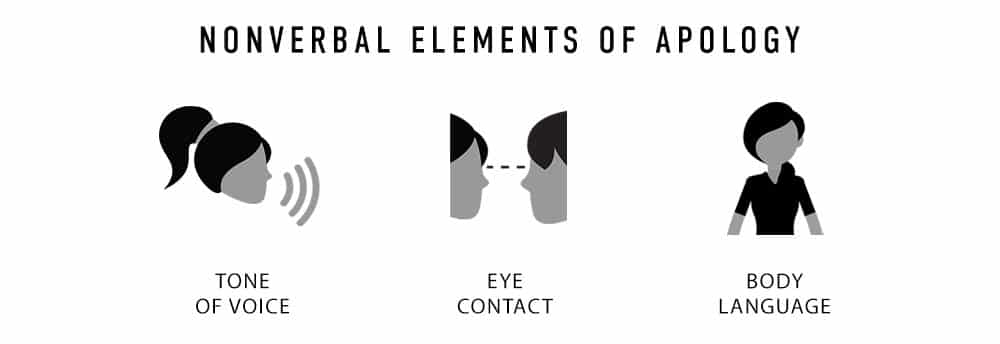
Square up, make eye contact, say it like you mean it, and then shut up and wait for the offended party’s response. And one more thing.
Don’t be a “But…”
When you are working to get these 10 difficult words out, there’s one word you absolutely must not use, or you will defeat all of your hard work.
The word is “but.” As in “I’m sorry, but…” You might not even intend to blame shift here. You might be trying to call attention to some extenuating circumstance that in the normal course of things would matter.
That’s not how it will be heard by the offended party in the moment, so do not do that if you want to heal the breach. If your goal is to make things right, then do yourself a huge favor and stick to the script.
Last modified on November 13th, 2023 at 9:44 am
Disclosure of Material Connection: Some of the links in the post above are “affiliate links.” This means if you click on the link and purchase the item, we will receive an affiliate commission. Regardless, we only recommend products or services we use and believe will add value to our readers. We are disclosing this in accordance with the Federal Trade Commission’s 16 CFR, Part 255: “Guides Concerning the Use of Endorsements and Testimonials in Advertising.