


Why Most Meetings Still Suck

Leading people and conducting meetings go hand-in-hand. Yes, you can use email, blogs, Twitter, Basecamp, or any number of additional tools. But at the end of the day, you will still need to schedule and lead meetings.
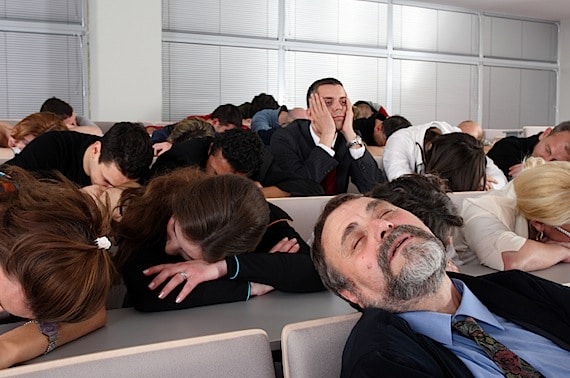
Photo courtesy of ©iStockphoto.com/TadejZupancic, Image #5896614

As long as you have to have meetings, you might as well do them well. Before you plan another meeting (and suffer the rest of us to sit through them), make a commitment to do the following:

  1. Define the outcome. I can’t over-emphasize this. If you don’t know what you are trying to accomplish, how will you or others know if you have succeeded? State the outcome at the beginning of the meeting. Here are some real-world examples:
    • “We are here to cast a vision for our international business.”
    • “We want to inspire people to run the half marathon.”
    • “We need to make a decision on when to launch the new Web site.”
    • “We need to review the survey results from the All Employee Meeting and then plan next quarter’s meeting.”
    • “We want to report on the progress of our new royalty system implementation.”
  2. Create a written agenda. People’s time is valuable. A meeting without an agenda is like a ship without a rudder. If you won’t take time to prepare an agenda, why should people take time to attend your meeting.
  3. Focus your attention. Demand that others focus theirs. Stay in the conversation. No laptops. No Blackberries. No side conversations. All of these things make meetings longer and less productive.
  4. Start and stop on time. As the leader you have to set the pace. Start the meeting on time whether everyone is there or not. End the meeting on time, whether you are done or not. If you create these “hard edges” on your meetings, you are more likely to achieve your outcomes.
Question: What other things can you do to improve your meetings, even if you are not the leader?
Disclosure of Material Connection: Some of the links in the post above are “affiliate links.” This means if you click on the link and purchase the item, I will receive an affiliate commission. Regardless, I only recommend products or services I use personally and believe will add value to my readers. I am disclosing this in accordance with the Federal Trade Commission’s 16 CFR, Part 255: “Guides Concerning the Use of Endorsements and Testimonials in Advertising.”

Get Free Email Updates!

Exclusive bonus! Subscribe today and you’ll receive a link to download my brand new e-book, Creating a Personal Life Plan, FREE. This step-by-step guide will help you design the life you’ve always wanted.

WestBow Press

Please note: I reserve the right to delete comments that are snarky, offensive, or off-topic. If in doubt, read My Comments Policy.

  • Pingback: I wish I didn’t know things… « It's not all about me, how quickly I forget…

  • http://twitter.com/john_gallagher john_gallagher

    Mike, I just love seeing some of these things pop up from your previous posts and how the timeing is impeccable. I have a 3-day meeting to facilitate with the Senior Management Team of a large organization coming up and all of these points are important. For meetings of this size, I do like to do a few other things: 1) set ground rules – you may cover this on your #3 above, but it may be bigger than these. Such as “one person talking at a time”, or “stay on topic”. For important topics outside of scope of meeting, I have a “Parking Lot” flip chart so the idea doesn’t get lost and can be discussed in the future. Then, I do a +/- at end of day. What went well, what didn’t go so well. Thanks for the idea spark! John Gallagher

  • Pmpope68

    Limit rabbit trails and leave time if possible for open discussion.

  • John Mark Harris

    5. Only have a meeting if you have a good reason, not just “it’s meeting time”

    • Anonymous

      Someone where I worked just cancelled a meeting because there wasn’t a lot of participation, although he would still like to see the information covered in another venue involving key players.  I suggested we just add an agenda item to an already existing meeting rather than create yet another meeting.  I think they’re going to take me up on that idea.  

      • http://michaelhyatt.com Michael Hyatt

        You made a great suggestion. It is always best to ask, “How can we incorporate this into something we are already doing.”

        • Anonymous

          Thanks.  The idea is still being “discussed”, so it’s yet to be seen what will actually happen.  

  • http://twitter.com/JobCoachHQ Douglas Andrews

    Absolutely bringing this to our next meeting.  Great points.  I think the most important comment is that time is valuable.  You should definitely leave a meeting with a clear understanding of what was just accomplished.  You better be “better off” than you were before you came in to the meeting.
    Thanks!

  • Bert

    Right on! Pat Lencioni’s book “Death By Meeting” is also great to try to modify this poorly used resource. If only the government could use a few of these principles in their meetings. Including cutting the number of meetings in half. (I’d add that to your list MH.)

  • Jptwin2

    Have attended way too many meetings that do not have a purpose, a goal. This leads to longer meetings and disgruntled employees who do not want to participate in or attend the next meeting!!

  • Pritchett4

    “no laptops” … ipads – I am responsible for chairing a number of meetings. I have noticed that a couple of folks are bringing their ipads with the agenda on them and taking notes. I have started taking a small (11.6 screen) computer with the agenda in Evernote and checking off items and taking notes in Evernote as well. Trying to get rid of paper (working toward the paperless office – thanks for your help). I know that it would be possible to write in a notebook, then scan as you have suggested, but it seems like that is an extra step. Can this “rule” be modified to work toward paperless (both for ecology as well as economy) in meetings? If so, what guidelines would you suggest? Thanks!

    • http://michaelhyatt.com Michael Hyatt

      Yes, I think so. I nee to update this post. iPads in particular have changed everything.

  • http://www.struggletovictory.com/ Kari Scare

    I have been to a lot of very bad meetings, and the good ones definitely have the elements listed in this post. The more I prepared in advance for meetings, such as by making a list of questions I had, also made a big difference. Also, when people do what they say they will do between meetings, a lot of progress is made. Otherwise, the meetings are the same every time with little to no progress made and projects taking a lot longer than they should.

©2008 Michael Hyatt, Powered by Standard Theme

Want to know how to get your book published? Start here!