



Why Most Meetings Still Suck

Leading people and conducting meetings go hand-in-hand. Yes, you can use email, blogs, Twitter, Basecamp, or any number of additional tools. But at the end of the day, you will still need to schedule and lead meetings.
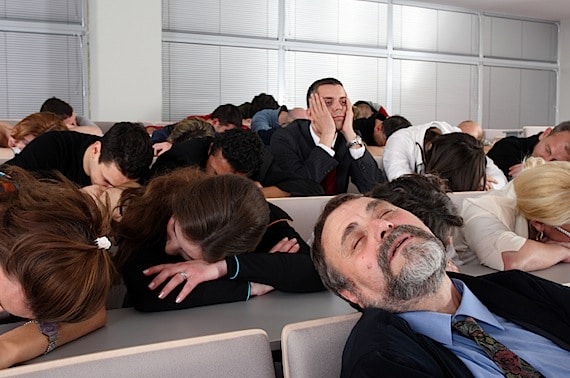
Photo courtesy of ©iStockphoto.com/TadejZupancic, Image #5896614

As long as you have to have meetings, you might as well do them well. Before you plan another meeting (and suffer the rest of us to sit through them), make a commitment to do the following:

  1. Define the outcome. I can’t over-emphasize this. If you don’t know what you are trying to accomplish, how will you or others know if you have succeeded? State the outcome at the beginning of the meeting. Here are some real-world examples:
    • “We are here to cast a vision for our international business.”
    • “We want to inspire people to run the half marathon.”
    • “We need to make a decision on when to launch the new Web site.”
    • “We need to review the survey results from the All Employee Meeting and then plan next quarter’s meeting.”
    • “We want to report on the progress of our new royalty system implementation.”
  2. Create a written agenda. People’s time is valuable. A meeting without an agenda is like a ship without a rudder. If you won’t take time to prepare an agenda, why should people take time to attend your meeting.
  3. Focus your attention. Demand that others focus theirs. Stay in the conversation. No laptops. No Blackberries. No side conversations. All of these things make meetings longer and less productive.
  4. Start and stop on time. As the leader you have to set the pace. Start the meeting on time whether everyone is there or not. End the meeting on time, whether you are done or not. If you create these “hard edges” on your meetings, you are more likely to achieve your outcomes.
Question: What other things can you do to improve your meetings, even if you are not the leader?
Disclosure of Material Connection: Some of the links in the post above are “affiliate links.” This means if you click on the link and purchase the item, I will receive an affiliate commission. Regardless, I only recommend products or services I use personally and believe will add value to my readers. I am disclosing this in accordance with the Federal Trade Commission’s 16 CFR, Part 255: “Guides Concerning the Use of Endorsements and Testimonials in Advertising.”

Get Free Email Updates!

Exclusive bonus! Subscribe today and you’ll receive a link to download my brand new e-book, Creating a Personal Life Plan, FREE. This step-by-step guide will help you design the life you’ve always wanted.

WestBow Press

Please note: I reserve the right to delete comments that are snarky, offensive, or off-topic. If in doubt, read My Comments Policy.

  • http://www.emergingintofaith.blogspot.com/ Dr. David Frisbie

    Should I die outside the grace of God (heaven forbid) then I will spend eternity in meetings.

    Dante missed a circle.

  • http://www.emergingintofaith.blogspot.com/ Dr. David Frisbie

    Should I die outside the grace of God (heaven forbid) then I will spend eternity in meetings.

    Dante missed a circle.

  • http://www.michaelhyatt.com/ Michael S. Hyatt

    @David: Now that is funny!

  • http://garridon.wordpress.com/ Linda

    << What other things can you do to improve your meetings, even if you are not the leader? <<

    Be prepared. If you know what the subject of the meeting is in advance, there's no reason not to be prepared.

    Show up a few minutes early. If you are presenting material using a computer, show up early enough to be able to set things up.

    If materials are being shown at the meeting, make sure they get out in advance--not five minutes before the meeting is about to happen.

  • http://garridon.wordpress.com/ Linda

    << What other things can you do to improve your meetings, even if you are not the leader? <<

    Be prepared. If you know what the subject of the meeting is in advance, there's no reason not to be prepared.

    Show up a few minutes early. If you are presenting material using a computer, show up early enough to be able to set things up.

    If materials are being shown at the meeting, make sure they get out in advance–not five minutes before the meeting is about to happen.

  • http://garridon.wordpress.com/ Linda

    << What other things can you do to improve your meetings, even if you are not the leader? <<

    Be prepared. If you know what the subject of the meeting is in advance, there's no reason not to be prepared.

    Show up a few minutes early. If you are presenting material using a computer, show up early enough to be able to set things up.

    If materials are being shown at the meeting, make sure they get out in advance–not five minutes before the meeting is about to happen.

  • http://true-small-caps.blogspot.com/ Derek Scottisman

    What other things can you do to improve your meetings

    The lazy man’s guide to success: Just surround yourself with people who are very, very good at what they do. Including being good at staying on topic.

  • http://true-small-caps.blogspot.com/ Derek Scottisman

    What other things can you do to improve your meetings

    The lazy man's guide to success: Just surround yourself with people who are very, very good at what they do. Including being good at staying on topic.

  • http://true-small-caps.blogspot.com/ Derek Scottisman

    What other things can you do to improve your meetings

    The lazy man's guide to success: Just surround yourself with people who are very, very good at what they do. Including being good at staying on topic.

  • http://www.paulwallis.net/ Paul Wallis

    Hi Mike,
    Amen to what you’ve shared here. When applied thoughtfully all these points apply to church-gathering too.

    In any meeting where conversation and decisions are involved our group also follows the advice of St Benedict in his C6th “Little Rule for Beginners”, Chapter Three – “concerning the calling of the brethren to council”.

    Benedict’s main points are that the leader’s role is to facilitate a conversation in which:

    1) every person is heard, even the most junior

    2) the matter must be clarified,

    3) everyone to seek first to understand the matter in hand

    4) each one speaks to the group’s purpose not out of a purely personal agenda

    5)the leader facilitates the drawing of a conclusion and the putting forward of a proposal for the group to own and act upon

    6) the right of the leader is reserved to ‘lead from the front’ and act on his own judgment. However Benedict’s strong advice is always to seek counsel before making a decision and as rarely as possible to act outside of the group’s conclusions. Benedict takes this as a tool for safeguarding God’s timing in important matters.

    We find all this still incredibly relevant. It may be relevant even to team meetings at ThomasNelson?!

    Thanks Again,

    Paul Wallis

  • http://www.paulwallis.net/ Paul Wallis

    Hi Mike,
    Amen to what you’ve shared here. When applied thoughtfully all these points apply to church-gathering too.

    In any meeting where conversation and decisions are involved our group also follows the advice of St Benedict in his C6th “Little Rule for Beginners”, Chapter Three – “concerning the calling of the brethren to council”.

    Benedict’s main points are that the leader’s role is to facilitate a conversation in which:

    1) every person is heard, even the most junior

    2) the matter must be clarified,

    3) everyone to seek first to understand the matter in hand

    4) each one speaks to the group’s purpose not out of a purely personal agenda

    5)the leader facilitates the drawing of a conclusion and the putting forward of a proposal for the group to own and act upon

    6) the right of the leader is reserved to ‘lead from the front’ and act on his own judgment. However Benedict’s strong advice is always to seek counsel before making a decision and as rarely as possible to act outside of the group’s conclusions. Benedict takes this as a tool for safeguarding God’s timing in important matters.

    We find all this still incredibly relevant. It may be relevant even to team meetings at ThomasNelson?!

    Thanks Again,

    Paul Wallis

  • http://www.paulwallis.net Paul Wallis

    Hi Mike,
    Amen to what you’ve shared here. When applied thoughtfully all these points apply to church-gathering too.

    In any meeting where conversation and decisions are involved our group also follows the advice of St Benedict in his C6th “Little Rule for Beginners”, Chapter Three – “concerning the calling of the brethren to council”.

    Benedict’s main points are that the leader’s role is to facilitate a conversation in which:

    1) every person is heard, even the most junior

    2) the matter must be clarified,

    3) everyone to seek first to understand the matter in hand

    4) each one speaks to the group’s purpose not out of a purely personal agenda

    5)the leader facilitates the drawing of a conclusion and the putting forward of a proposal for the group to own and act upon

    6) the right of the leader is reserved to ‘lead from the front’ and act on his own judgment. However Benedict’s strong advice is always to seek counsel before making a decision and as rarely as possible to act outside of the group’s conclusions. Benedict takes this as a tool for safeguarding God’s timing in important matters.

    We find all this still incredibly relevant. It may be relevant even to team meetings at ThomasNelson?!

    Thanks Again,

    Paul Wallis

  • http://www.paulwallis.net/ Paul Wallis

    Hi Mike,
    Amen to what you've shared here. When applied thoughtfully all these points apply to church-gathering too.

    In any meeting where conversation and decisions are involved our group also follows the advice of St Benedict in his C6th "Little Rule for Beginners", Chapter Three – "concerning the calling of the brethren to council".

    Benedict's main points are that the leader's role is to facilitate a conversation in which:

    1) every person is heard, even the most junior

    2) the matter must be clarified,

    3) everyone to seek first to understand the matter in hand

    4) each one speaks to the group's purpose not out of a purely personal agenda

    5)the leader facilitates the drawing of a conclusion and the putting forward of a proposal for the group to own and act upon

    6) the right of the leader is reserved to 'lead from the front' and act on his own judgment. However Benedict's strong advice is always to seek counsel before making a decision and as rarely as possible to act outside of the group's conclusions. Benedict takes this as a tool for safeguarding God's timing in important matters.

    We find all this still incredibly relevant. It may be relevant even to team meetings at ThomasNelson?!

    Thanks Again,

    Paul Wallis

  • http://www.linkedin.com/in/petenikolai Pete Nikolai

    Would it be productive to establish the following Meeting Mandates here at Nelson?

    1) an explicit outcome/purpose in the Meeting Request

    2) an agenda at least 24 hours prior to the meeting with clear indication of who is responsible for taking and forwarding the notes within 24 hours after the meeting

    The consequence of violating either of these Mandates could be as simple as people declining the Meeting Request.

    From my perspective, the only valid purposes for meetings are to debate (and possibly then to make a decision), to brainstorm, to celebrate positive accomplishments, and to acknowledge major negative developments and brainstorm course corrections. Meetings should never be used just to communicate information or build relationships.

    Most workers can quickly identify their co-workers who seem to think that nothing can get done without discussing it in a meeting first. While there are legitimate reasons for gathering people together (as stated above), far too often the little that is actually accomplished in a meeting could have been done in more efficient ways. Information could be communicated via email. Relationships could be built over lunch or a round of golf. Socializing could happen at more appropriate times in more appropriate places.

    The other dysfunctional aspect of many meetings is the strange manifestation known as the “presentation.” Any vital information (other than surprise announcements) contained in a presentation should be sent in an email at least 24 hours in advance so that participants have time to review and research prior to the meeting. Then the meeting should consist of a quick debate or brainstorming session by informed participants. Vital information can be put on screen, but there is no need for that information to be presented—people need to be trusted to have done their homework.

    Perhaps the most frustrating thing about meetings is that many of the people involved know they could be using that time to get their prioritized Tasks done so that they can have more time for other important things (at work or elsewhere). If the organization clearly supports best practices such as those outlined above, workers should be able to reclaim considerable time to do just that.

  • http://www.linkedin.com/in/petenikolai Pete Nikolai

    Would it be productive to establish the following Meeting Mandates here at Nelson?

    1) an explicit outcome/purpose in the Meeting Request

    2) an agenda at least 24 hours prior to the meeting with clear indication of who is responsible for taking and forwarding the notes within 24 hours after the meeting

    The consequence of violating either of these Mandates could be as simple as people declining the Meeting Request.

    From my perspective, the only valid purposes for meetings are to debate (and possibly then to make a decision), to brainstorm, to celebrate positive accomplishments, and to acknowledge major negative developments and brainstorm course corrections. Meetings should never be used just to communicate information or build relationships.

    Most workers can quickly identify their co-workers who seem to think that nothing can get done without discussing it in a meeting first. While there are legitimate reasons for gathering people together (as stated above), far too often the little that is actually accomplished in a meeting could have been done in more efficient ways. Information could be communicated via email. Relationships could be built over lunch or a round of golf. Socializing could happen at more appropriate times in more appropriate places.

    The other dysfunctional aspect of many meetings is the strange manifestation known as the “presentation.” Any vital information (other than surprise announcements) contained in a presentation should be sent in an email at least 24 hours in advance so that participants have time to review and research prior to the meeting. Then the meeting should consist of a quick debate or brainstorming session by informed participants. Vital information can be put on screen, but there is no need for that information to be presented—people need to be trusted to have done their homework.

    Perhaps the most frustrating thing about meetings is that many of the people involved know they could be using that time to get their prioritized Tasks done so that they can have more time for other important things (at work or elsewhere). If the organization clearly supports best practices such as those outlined above, workers should be able to reclaim considerable time to do just that.

  • http://www.linkedin.com/in/petenikolai Pete Nikolai

    Would it be productive to establish the following Meeting Mandates here at Nelson?

    1) an explicit outcome/purpose in the Meeting Request

    2) an agenda at least 24 hours prior to the meeting with clear indication of who is responsible for taking and forwarding the notes within 24 hours after the meeting

    The consequence of violating either of these Mandates could be as simple as people declining the Meeting Request.

    From my perspective, the only valid purposes for meetings are to debate (and possibly then to make a decision), to brainstorm, to celebrate positive accomplishments, and to acknowledge major negative developments and brainstorm course corrections. Meetings should never be used just to communicate information or build relationships.

    Most workers can quickly identify their co-workers who seem to think that nothing can get done without discussing it in a meeting first. While there are legitimate reasons for gathering people together (as stated above), far too often the little that is actually accomplished in a meeting could have been done in more efficient ways. Information could be communicated via email. Relationships could be built over lunch or a round of golf. Socializing could happen at more appropriate times in more appropriate places.

    The other dysfunctional aspect of many meetings is the strange manifestation known as the “presentation.” Any vital information (other than surprise announcements) contained in a presentation should be sent in an email at least 24 hours in advance so that participants have time to review and research prior to the meeting. Then the meeting should consist of a quick debate or brainstorming session by informed participants. Vital information can be put on screen, but there is no need for that information to be presented—people need to be trusted to have done their homework.

    Perhaps the most frustrating thing about meetings is that many of the people involved know they could be using that time to get their prioritized Tasks done so that they can have more time for other important things (at work or elsewhere). If the organization clearly supports best practices such as those outlined above, workers should be able to reclaim considerable time to do just that.

  • http://www.linkedin.com/in/petenikolai Pete Nikolai

    Would it be productive to establish the following Meeting Mandates here at Nelson?

    1) an explicit outcome/purpose in the Meeting Request

    2) an agenda at least 24 hours prior to the meeting with clear indication of who is responsible for taking and forwarding the notes within 24 hours after the meeting

    The consequence of violating either of these Mandates could be as simple as people declining the Meeting Request.

    From my perspective, the only valid purposes for meetings are to debate (and possibly then to make a decision), to brainstorm, to celebrate positive accomplishments, and to acknowledge major negative developments and brainstorm course corrections. Meetings should never be used just to communicate information or build relationships.

    Most workers can quickly identify their co-workers who seem to think that nothing can get done without discussing it in a meeting first. While there are legitimate reasons for gathering people together (as stated above), far too often the little that is actually accomplished in a meeting could have been done in more efficient ways. Information could be communicated via email. Relationships could be built over lunch or a round of golf. Socializing could happen at more appropriate times in more appropriate places.

    The other dysfunctional aspect of many meetings is the strange manifestation known as the “presentation.” Any vital information (other than surprise announcements) contained in a presentation should be sent in an email at least 24 hours in advance so that participants have time to review and research prior to the meeting. Then the meeting should consist of a quick debate or brainstorming session by informed participants. Vital information can be put on screen, but there is no need for that information to be presented—people need to be trusted to have done their homework.

    Perhaps the most frustrating thing about meetings is that many of the people involved know they could be using that time to get their prioritized Tasks done so that they can have more time for other important things (at work or elsewhere). If the organization clearly supports best practices such as those outlined above, workers should be able to reclaim considerable time to do just that.

  • http://www.john-gallagher.blogspot.com/ John Gallagher

    Not enough just to focus. It is important to PARTICIPATE.

  • http://www.john-gallagher.blogspot.com/ John Gallagher

    Not enough just to focus. It is important to PARTICIPATE.

  • http://www.john-gallagher.blogspot.com John Gallagher

    Not enough just to focus. It is important to PARTICIPATE.

  • http://www.john-gallagher.blogspot.com/ John Gallagher

    Not enough just to focus. It is important to PARTICIPATE.

  • http://www.linkedin.com/in/klolund Kyle Olund

    Good thoughts, Pete. What is necessary is better discernment to know when an e-mail should be sent instead of a meeting request, and when a meeting should be called to avoid an onslaught of e-mails on one topic/problem (that happened yesterday, and if we were all in the same building we could have met instead of seen 40+ e-mails exchange between different people–a least that’s how many ended up in my in- or cc-box).

  • http://www.linkedin.com/in/klolund Kyle Olund

    Good thoughts, Pete. What is necessary is better discernment to know when an e-mail should be sent instead of a meeting request, and when a meeting should be called to avoid an onslaught of e-mails on one topic/problem (that happened yesterday, and if we were all in the same building we could have met instead of seen 40+ e-mails exchange between different people–a least that’s how many ended up in my in- or cc-box).

  • http://www.linkedin.com/in/klolund Kyle Olund

    Good thoughts, Pete. What is necessary is better discernment to know when an e-mail should be sent instead of a meeting request, and when a meeting should be called to avoid an onslaught of e-mails on one topic/problem (that happened yesterday, and if we were all in the same building we could have met instead of seen 40+ e-mails exchange between different people–a least that’s how many ended up in my in- or cc-box).

  • http://www.linkedin.com/in/klolund Kyle Olund

    Good thoughts, Pete. What is necessary is better discernment to know when an e-mail should be sent instead of a meeting request, and when a meeting should be called to avoid an onslaught of e-mails on one topic/problem (that happened yesterday, and if we were all in the same building we could have met instead of seen 40+ e-mails exchange between different people–a least that's how many ended up in my in- or cc-box).

  • Pingback: Leadership, Productivity and Books… » 17 Hours – This Better Be Worth It!

  • http://jeffgoins.myadventures.org/ jeff

    Nice post, Michael – looks like an oldie, but a goodie. Not to sound contradictory, but my experience has been showed me that sometimes, meetings that even meet these parameters can still suck. They can be dull or predictable. They can become rote or meaningless.

    For me, a remarkable meeting shows respect to all of the attendees (a non-negotiable), but it also goes beyond that. It's creative, interactive, and, in some cases, leaderless. Most meetings are monologues or uncreative in their use of technology and media. I like having an predefined outcome/goal, but sometimes that can be as simple as saying, "We're going to discover X" in this meeting.

    For me, a meeting is a success if people want to come back to the next one. We do evaluations at the end of each meeting, and this keeps my humble. Some are great; some, not so much. I experiment with giving the floor to different speakers/facilitators, and we're learning together how to makes these times more valuable.

    Other than Lencioni, who else would you recommend?

  • http://jeffgoins.myadventures.org/ jeff

    Nice post, Michael – looks like an oldie, but a goodie. Not to sound contradictory, but my experience has been showed me that sometimes, meetings that even meet these parameters can still suck. They can be dull or predictable. They can become rote or meaningless.

    For me, a remarkable meeting shows respect to all of the attendees (a non-negotiable), but it also goes beyond that. It's creative, interactive, and, in some cases, leaderless. Most meetings are monologues or uncreative in their use of technology and media. I like having an predefined outcome/goal, but sometimes that can be as simple as saying, "We're going to discover X" in this meeting.

    For me, a meeting is a success if people want to come back to the next one. We do evaluations at the end of each meeting, and this keeps my humble. Some are great; some, not so much. I experiment with giving the floor to different speakers/facilitators, and we're learning together how to makes these times more valuable.

    Other than Lencioni, who else would you recommend?

  • http://jeffgoins.myadventures.org jeff

    Nice post, Michael – looks like an oldie, but a goodie. Not to sound contradictory, but my experience has been showed me that sometimes, meetings that even meet these parameters can still suck. They can be dull or predictable. They can become rote or meaningless.

    For me, a remarkable meeting shows respect to all of the attendees (a non-negotiable), but it also goes beyond that. It's creative, interactive, and, in some cases, leaderless. Most meetings are monologues or uncreative in their use of technology and media. I like having an predefined outcome/goal, but sometimes that can be as simple as saying, "We're going to discover X" in this meeting.

    For me, a meeting is a success if people want to come back to the next one. We do evaluations at the end of each meeting, and this keeps my humble. Some are great; some, not so much. I experiment with giving the floor to different speakers/facilitators, and we're learning together how to makes these times more valuable.

    Other than Lencioni, who else would you recommend?

  • D Shick

    While I understand the motive behind the no blackberry/no laptop rule, I have begun using Microsoft One Note to input my personal meeting notes. I've also found it helpful to look back on the notes from previous meetings using the programs valuable search tool. So I'm not ready to subscribe to that rule just yet and wonder how others feel? Good topic.

  • D Shick

    While I understand the motive behind the no blackberry/no laptop rule, I have begun using Microsoft One Note to input my personal meeting notes. I've also found it helpful to look back on the notes from previous meetings using the programs valuable search tool. So I'm not ready to subscribe to that rule just yet and wonder how others feel? Good topic.

  • D Shick

    While I understand the motive behind the no blackberry/no laptop rule, I have begun using Microsoft One Note to input my personal meeting notes. I've also found it helpful to look back on the notes from previous meetings using the programs valuable search tool. So I'm not ready to subscribe to that rule just yet and wonder how others feel? Good topic.

  • D Shick

    While I understand the motive behind the no blackberry/no laptop rule, I have begun using Microsoft One Note to input my personal meeting notes. I've also found it helpful to look back on the notes from previous meetings using the programs valuable search tool. So I'm not ready to subscribe to that rule just yet and wonder how others feel? Good topic.

  • http://amothersangst.blogspot.com Fran

    These are good suggestions. I don't enforce a "no electronics" rule – I find that by having the agenda published in advance, starting on time, moving quickly through the topics and soliciting input (i.e. "Michael, what are your thoughts on this?") people tend to stay engaged. The only other suggestion I might add is to publish minutes.
    My recent post Bo's Cafe – a Book Review

  • http://amothersangst.blogspot.com/ Fran

    These are good suggestions. I don't enforce a "no electronics" rule – I find that by having the agenda published in advance, starting on time, moving quickly through the topics and soliciting input (i.e. "Michael, what are your thoughts on this?") people tend to stay engaged. The only other suggestion I might add is to publish minutes.
    My recent post Bo's Cafe – a Book Review

  • http://amothersangst.blogspot.com/ Fran

    These are good suggestions. I don't enforce a "no electronics" rule – I find that by having the agenda published in advance, starting on time, moving quickly through the topics and soliciting input (i.e. "Michael, what are your thoughts on this?") people tend to stay engaged. The only other suggestion I might add is to publish minutes.
    My recent post Bo's Cafe – a Book Review

  • http://amothersangst.blogspot.com/ Fran

    These are good suggestions. I don't enforce a "no electronics" rule – I find that by having the agenda published in advance, starting on time, moving quickly through the topics and soliciting input (i.e. "Michael, what are your thoughts on this?") people tend to stay engaged. The only other suggestion I might add is to publish minutes.
    My recent post Bo's Cafe – a Book Review

  • http://twitter.com/RichardJett @RichardJett

    Is giving money or a treat to those who answer/interact inappropriate? Kidding…kind of. Great article.

  • http://twitter.com/RichardJett @RichardJett

    Is giving money or a treat to those who answer/interact inappropriate? Kidding…kind of. Great article.

  • http://twitter.com/RichardJett @RichardJett

    Is giving money or a treat to those who answer/interact inappropriate? Kidding…kind of. Great article.

  • http://twitter.com/RichardJett @RichardJett

    Is giving money or a treat to those who answer/interact inappropriate? Kidding…kind of. Great article.

  • Pingback: Most Tweeted Articles by Leadership Development Experts

  • http://intensedebate.com/profiles/yaplefive yaplefive

    If the leader of the meeting isn't taking the time to listen to everyone's thoughts, make sure it happens.

    It may seem obvious, but if everyone was invited to the meeting for a reason…take the time to make sure everyone is listened to.

  • http://bradleyaharmon.com Brad Harmon

    I’ve found it helpful to do #1 & #2 and send it to the meeting participants ahead of time. Let them know what there part in the meeting will be. Not only will this keep their attention knowing you may call on them at any point to fulfill that expectation, but they’re more likely to contribute some valuable ideas.

  • Pingback: Clear Your Desk, Clear Your Mind

  • Thomas Stanley

    a great way to make the meeting matter afterward is to have meeting agreements with deadlines and review them at the end of each meeting.

  • Chadwardwm

    Love the post!
    1. Let others have thier moment in the spot light. Let others lead portions of it.
    2. Provide hot beverages and “brain food.”
    3. Never start an important meeting about strategic topics after 3PM!
    4. Don’t meet once a quarter and instead do something that is fun team building.

  • http://twitter.com/NewEnglandHiker Roy Wallen

    Once again, great insight. The only thing I can offer is the suggestion that these four items be written in advance. Provide the objective and agenda in writing and in advance. Tell, in writing, people to leave laptops and BlackBerry devices (is it BlackBerries?) behind — including your boss(es) — in the interest of courtesy and productivity. Don’t wait for stragglers to start the meeting and don’t let the meeting run over — and tell people that’s how meetings will run.

  • http://twitter.com/lovinglyyoursG Georgiana

    Meetings are necessary to keep everyone informed and on the same page of what’s going on. Definitely timing is important with a set beginning and end as nothing will ever be accomplished by just talking. By keeping with a detailed itinerary people know what to expect. Follow up is essential too as the action and results of the participants is what’s really the telling sign of a meeting’s effectiveness.

  • Ashley Musick

    I found this very helpful. I’m just now working in a position where I lead meetings every once in a while. These tips can keep me on track.

©2008 Michael Hyatt, Powered by Standard Theme

Want to know how to get published? Check out this step-by-step guide. Click here!